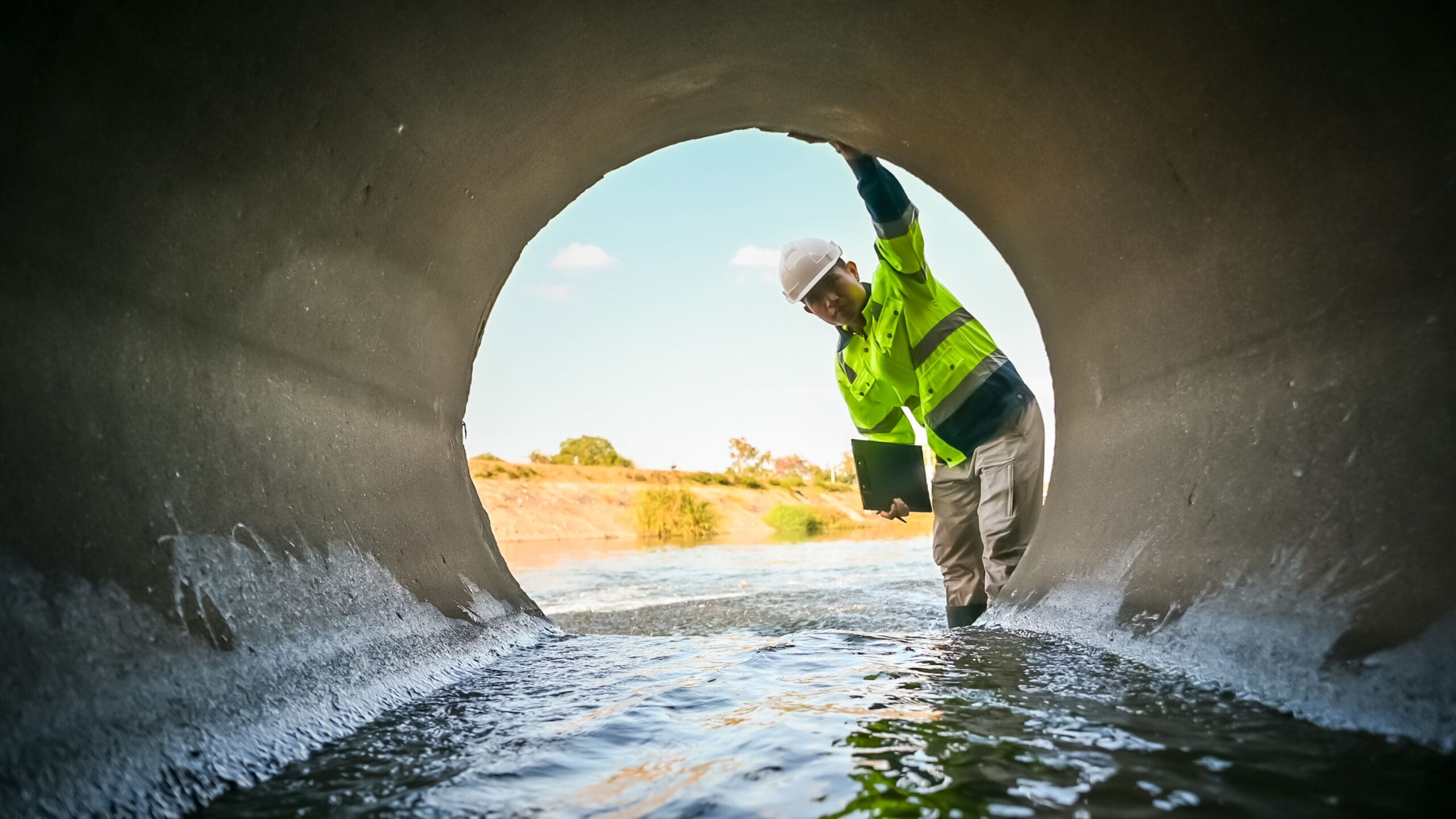
A Water Utility’s Guide to GIS-Based Asset Management Software

Water utilities managing aging infrastructure, workforce transitions, and tightening compliance requirements need more than disconnected spreadsheets and paper records. When asset data, work orders, and field updates live in separate systems, decisions slow down, reporting becomes manual, and field crews operate without a complete picture. GIS-based asset management software gives utility teams a map-first, real-time view of field data, work orders, and asset records, closing the gap between the field and the office and building the data foundation that water network management depends on.

The average US water main is more than 45 years old, and pipes laid during the postwar boom are approaching the end of their design life just as EPA compliance requirements tighten, lead service line inventory mandates expand, and a workforce where more than 30 percent of employees are within five years of retirement. Managing all of it is difficult when field data, work orders, and GIS records live in separate systems that rarely interact. That’s the problem a GIS-based asset management platform is built to solve.

Why Water Utility Asset Management Is Getting Harder

Aging infrastructure is the most visible pressure point. Deteriorating mains require more frequent inspections and more detailed documentation, at the same time experienced crews are retiring. When those crews leave, they take decades of institutional knowledge with them: which valves are temperamental, which mains have a history of leaks, which neighborhoods have the oldest service lines. Without a system that captures that knowledge, the next generation of field technicians is forced to rebuild that understanding over time.

Regulatory demands compound the pressure. Utilities must demonstrate not just that work was completed, but that it was completed correctly, on schedule, and with a full documentation trail. That process becomes time-consuming and error-prone when data is scattered across paper logs, disconnected spreadsheets, and GIS systems that are updated after the fact, leaving compliance teams to assemble reports manually from multiple sources.

What GIS-Based Asset Management Actually Looks Like

The shift to GIS-based asset management isn’t just a technology upgrade; it’s a change in how information flows through the organization. A map-first asset management platform creates a single, continuously updated record that field crews and operations staff share in real time. For water utilities, the most impactful capabilities cluster around four areas

  • Offline-capable mobile data collection. Field crews working near buried mains or remote pump stations often operate without reliable connectivity. A platform that functions fully offline, and syncs automatically when connectivity returns, ensures inspections are documented without gaps or duplicate entry.
  • Real-time sync between field and GIS. When a technician updates an asset record in the field, that change should be reflected in the system immediately, not 48 hours later when it’s no longer useful for scheduling or compliance reporting.
  • Configurable workflows for water-specific tasks. Hydrant inspections, valve exercising, leak surveys, and main break response all have different data requirements. A map-first platform that lets operations teams build and modify those workflows without custom development can adapt to a utility’s unique needs.
  • Protection for your existing GIS investment. Platforms that integrate cleanly with ArcGIS Online, ArcGIS Enterprise, and the Esri Utility Network preserve what utilities have already built. For utilities migrating from legacy systems like GE Smallworld or Hexagon, tools like EpochSync Pro handle data synchronization that would otherwise require months of manual effort.

What Your GIS Team Should Pressure-Test

Platform evaluations should reflect how your operations actually funtion, not how a vendor demo is configured. Focus on the conditions your team deals with every day. Here are some critical questions to ask:

  • Does it work offline reliably? Ask how the platform handles data conflicts when field devices reconnect after an extended offline use.
  • Will my field crews actually use it? A map-first interface that surfaces relevant GIS data at the job site is the difference between a tool that gets used and one that gets worked around.
  • How well does it integrate with existing the systems? Confirm how it connects to GIS, EAM or ERP platforms, and legacy data sources without creating duplicate data environments?

How Connected Data Changes Operational Decisions for Water Utilities

When field data flows in real time, maintenance scheduling shifts from reactive to predictive, compliance reporting becomes a byproduct of normal operations rather than a quarterly scramble, and a single dashboard replaces the manually assembled reports that currently consume operations staff time.

Connected data also addresses one of the most underappreciated risks in water utility operations: knowledge loss at retirement. A GIS-based platform that captures asset history, inspection records, and maintenance patterns as part of daily work preserves that institutional knowledge in the system, making it accessible to the next crew without a formal handoff.

Dominion Energy, which serves approximately 6 million customers across 15 states, implemented EpochField specifically to solve this problem. Transmission line workers had been manually downloading large mapping files and struggling to access reliable GIS data in the field, particularly in rural areas with unreliable Internet connectivity. After deploying EpochField’s map-first mobile platform, crews can now access up-to-date asset records and access road information on their phones and tablets, online or offline.

“Our line workers like that the EpochField application is basically in their pocket, available on their phone,” said Matthew Rogers, supervisor of electric transmission lines operations at Dominion. The utility is now extending EpochField further, integrating it with its SAP enterprise system to bring 80 years of asset history directly into field inspection workflows.

See It in Action at AWWA ACE26 in Washington, D.C.

The Epoch Solutions Group team will be at the American Water Works Association (AWWA)’s Annual Conference & Exposition (ACE), June 21–24, 2026, to talk through these challenges with water utility professionals. Stop by booth #969 to see EpochField and EpochSync Pro in action, or schedule a demo before the show so we can make the most of your time in D.C.

See How EpochField Modernizes Water Utility Asset Management

Not making the trip to ACE26? Contact us to explore how our map-first solutions are helping water utilities modernize field operations, close the gap between GIS and the field, and build the data foundation that compliance and capital planning depend on.

Gradient Navy Teal Map Centric Mobile

About Water Utility Asset Management Software

Water utility asset management software connects field data, GIS records, and work orders in a single system. It enables water utility teams to track asset conditions, schedule inspections, document maintenance, and meet compliance requirements, replacing paper-based processes with real-time, auditable data that operations and GIS teams can act on immediately.

GIS asset management software overlays asset records, inspection history, and work orders directly onto a map of the water network. Field crews arrive at job sites with accurate, current data on their mobile device. Operations managers gain a real-time view of network status without waiting for end-of-day reports, improving scheduling, maintenance prioritization, and emergency response across the distribution system.

Prioritize offline capability, configurability, and integration with your existing GIS. Water utility management software should work reliably where cell service is unavailable, adapt to water-specific workflows like hydrant inspections and valve exercising without custom development, and connect cleanly to platforms like ArcGIS or legacy systems like GE Smallworld, without requiring duplicate data management across multiple systems.

Digital transformation in utilities means replacing manual, paper-based field processes with connected, data-driven systems. For water utilities, it starts with GIS-based asset management: digitizing inspections, automating work order creation, and syncing field data in real time. The result is a shift from reactive maintenance to predictive operations and compliance reporting that happens as a byproduct of daily work, not a separate effort.

When experienced crews retire, they take decades of operational knowledge with them. GIS asset management software captures asset history, inspection records, and maintenance patterns as part of normal daily workflows, preserving that institutional knowledge in the system rather than in individual memory. New field technicians inherit a complete, searchable record of the network rather than starting from scratch.

AWWA ACE26

Countdown to AWWA ACE26!

JUNE 22-24, 2026 | WASHINGTON, D.C.

Connect with Us at ACE26

Join Epoch Solutions Group at AWWA ACE26 in Booth #969 to discover how mobile workforce management solutions are powering the next generation of water utilities. Stop by during booth hours to see live demos and connect with our team.

ACE is one of the global water community’s largest and most important annual gatherings. Water professionals return to ACE to discover the latest water information, learn skills and best practices, meet colleagues, share ideas and experiences, find new solutions, get inspired, and have fun. ACE provides fresh insights, new solutions, and powerful connections to water professionals everywhere.

Water utilities are navigating growing complexity—upgrading aging infrastructure like pipes and treatment plants while managing intensifying water scarcity, stricter contamination regulations, and emerging contaminants such as PFAS.

At Epoch Solutions Group, we’re committed to helping utilities streamline field operations, accelerate modernization, and build more resilient networks with Esri-based solutions that deliver measurable results.

Expo Date Booth Hours
Monday, June 22 10:00 AM - 5:00 PM
Tuesday, June 23 10:00 AM - 5:30 PM
Wednesday, June 24 10:00 AM - 1:00 PM

Exploring Salt River Project & Epoch Solutions Group’s Long-Term Partnership in an Evolving Utility Landscape

Project Summary

Project Type:

Modernization of SRP’s GIS architecture through deployment of EpochSync and EpochField,  which including replacing deprecated GE Insync replication technology, enabling Esri-based system of engagement, and expanding field operations with mobile GIS tools

Number of Customers: 

2 million+

Location: 

Central Arizona

Applications:

To provide internal users and field crews with fast, reliable access to spatial data for inspections, maintenance, vegetation management, asset updates, and more

To power over 30 business applications and 20+ system integrations including Maximo, SAP, ADMS, and 811

Solutions Implemented:

 
EpochSync
 
EpochField

Customer Benefits:

Seamless data replication from Smallworld to Esri ArcGIS with minimal IT overhead

Offline-first mobile access to GIS for 400+ field employees

Unified mobile interface for inspections, work orders, and updates

Real-time GIS data feeds to mission-critical systems like ADMS

Reduced time to deploy new GIS-based applications

Trusted long-term support from a knowledgeable integration partner

Introduction

Salt River Project (SRP) is a nonprofit organization serving more than two million people across central Arizona with reliable, affordable utilities. It delivers electricity to over one million customers in metropolitan Phoenix and manages a large water network that supports both agriculture and urban growth.

groundwater icon animated

13,000

square miles of watershed area

Powerline icon animated

2,800

square miles of electric service area

To keep power and water flowing across a region that spans cities, farmland, and desert, SRP depends on systems that are scalable, stable, and tightly integrated. That need is especially critical for geographic information systems (GIS) and field operations, where real-time data and efficient workflows have become essential to daily performance.

The Challenge

In the early 2000s, SRP’s entire GIS ran on GE Smallworld. While effective as a system of record, it limited the utility’s ability to deliver timely, accessible network data to planners, engineers, and field crews. As SRP’s operational demands grew, so did the need for a more flexible, enterprise-ready GIS architecture. To modernize and unlock broader value from their spatial data, SRP turned to Epoch Solutions Group.

Leading the effort on SRP’s side was Mark Ledbetter, Senior Manager of Enterprise Spatial and Mobility Services. “When Epoch presented their solution during the RFP process, I was impressed, but I’ll admit I was a little skeptical,” he said. “Can they really pull this off? But they came in and delivered. It worked right out of the gate, and we didn’t hit any major bumps.”

Epoch Solutions Group was already familiar with SRP’s data model and technical environment, which made them a natural fit. Together, the organizations built a hybrid GIS architecture that played to each system’s strengths: Smallworld remained the system of record, while Esri ArcGIS became the system of engagement. This approach gave SRP stability where it mattered most, and also flexibility where needed.

The hybrid architecture gave SRP a strong, future-ready foundation, but it came with one major issue: data replication between Smallworld and Esri depended on GE’s Insync middleware. When GE announced it was retiring the product, SRP had a tough decision to make. The most straightforward fix was to rebuild the sync pipeline from the ground up, but that would have meant a long, costly, and highly disruptive project.

At the same time, SRP’s field crews were using a mix of disconnected tools to get their work done. Some still relied on paper maps. Others had to switch between separate apps for mapping, work orders, and photo capture. Each layer of complexity slowed things down and further underscored the need for a single, modern solution.

The Solution

Epoch Solutions Group delivered on both fronts, combining a deep understanding of SRP’s data architecture with a proven track record in utility GIS modernization. First, they introduced EpochSync, a configurable data migration tool that allowed SRP to fully replace GE Insync without rebuilding integrations from scratch. Because EpochSync could reuse the configuration files SRP had already developed, the deployment took only two to three months. The system has now run daily for over a decade.

“We had considered other options, but it would have meant starting over,” recalled Ledbetter. “Anything else would have taken much longer and cost far more.”

Since adopting EpochSync, SRP has steadily expanded the impact of its GIS across the enterprise. The Esri-based system of engagement now supports more than 30 GIS-powered business applications and integrates with over 20 internal and external systems, including Maximo, SAP, CIS, Arizona 811, GeoTAB, and SRP’s Advanced Distribution Management System (ADMS). EpochSync serves as the reliable data pipeline that delivers accurate, up-to-date spatial data to each of these tools.

“EpochSync is the jugular vein of our GIS ecosystem,” said Ledbetter. “It feeds everything. Mobile apps, web maps, analytics. It’s critical to operational systems.”

The architecture also enabled SRP to scale mobile access to geospatial data. Every SRP employee now has access to GIS data through the enterprise Esri web map, and more than 400 field employees use mobile solutions powered by Epoch Solutions Group software in their daily work. These tools support asset inspections, vegetation management, meter installations, and equipment serialization, all based on live, accurate data.

Next Up: The Field Transformation

In 2024, SRP began rolling out EpochField, which is Epoch Solutions Group’s modern mobile mapping and work management solution. The goal is to simplify daily operations for over 400 field employees by replacing SRP’s scattered tools with a single, unified app. When the integration is complete, crews will be able to access maps, work orders, photos, and updates—all in one place, with one login.

EpochField’s architecture is especially valuable to SRP because of its flexibility. Unlike off-the-shelf products that would have forced a one-size-fits-all approach, EpochField is able to be configured to SRP’s specific needs without custom development.

Early feedback has been promising. Field supervisors have reported fewer support requests and more consistent workflows across departments. “We envision a future where our field crews receive work assignments and update work orders through EpochField,” said Ledbetter, “instead of switching between multiple applications and login processes.”

The Results

Nearly two decades after first rethinking its GIS architecture with Epoch Solutions Group, SRP now runs one of the most robust, adaptable geospatial platforms in the utility space. With support from the Epoch team, SRP has scaled its system to effectively meet growing demand across planning, operations, and field execution.

Today, the architecture supports more than 30 GIS-powered business applications and over 20 live integrations, from enterprise platforms like SAP and Maximo to field systems and operational tools. More than 400 field employees use mobile workflows powered by EpochField, while all SRP staff can access spatial data through the enterprise Esri map.

EpochSync replaced GE’s deprecated sync technology quickly and efficiently, avoiding a costly rebuild and proving reliable over time.

Perhaps most telling of all: two decades after the system was first implemented, that same foundation continues to power new tools, workflows, and integrations—without requiring a re-platform or large-scale rework.

Industry Context

SRP’s story reflects broader changes in the utility industry. GIS has moved from static map-making to real-time operational modeling. Outage management and infrastructure planning now rely on complete and timely spatial data. Meanwhile, smartphones have changed how field teams work, and distributed energy resources like rooftop solar and electric vehicles have added pressure on utilities to model and manage the grid with precision.

“There’s a heightened emphasis on complete, timely, and accurate GIS data,” said Ledbetter. “Our current GIS strategies are very focused on making sure that data flows everywhere it’s needed, in real time.”

Epoch Solutions Group’s tools help make that possible. EpochSync ensures every integrated system works from the same authoritative source, while EpochField brings relevant, reliable information directly to the people doing the work.

Looking Ahead

SRP plans to use EpochField as its primary mobile interface for all field-based tasks. Work assignments, inspections, and updates will flow through the same interface, reducing the need for multiple systems. The team is also exploring how to use synchronized GIS data to support emerging use cases like predictive maintenance, vegetation risk analysis, and meter health scoring.

As the electric grid becomes more dynamic and digitally enabled, SRP expects its hybrid GIS foundation to grow in importance. “We’ve built a platform that’s ready for what’s next,” Ledbetter said.

Conclusion

For utilities considering a similar transformation, Ledbetter offers this guidance: “Choose partners who understand your data, invest in configurable tools that evolve with your needs, and build relationships you can rely on over the long term. With deep domain knowledge, flexible technology, and a collaborative approach, the right partner can make modernization faster, smoother, and more successful.”

Epoch Solutions Group has supported SRP through every stage of its GIS transformation, from foundational data replication to integrated mobile fieldwork. If your utility is exploring similar goals, talk to an Epoch utility specialist to discuss your needs.