
Moving to the Esri Utility Network: The Ultimate Guide to Achieving a Smooth Transition

With power demand and extreme weather wreaking havoc on energy reliability, utility networks are pressured like never before. Legacy networks are not conducive to managing large, complex data sets, nor do they transform that data into insights that facilitate informed, GIS-based decision-making.

For reasons like these, many utilities are migrating to the Esri ArcGIS Utility Network—a modern framework that simplifies the task of managing a complex network with high fidelity and scalability. But while the Utility Network offers significant business benefits, making the switch can feel like an overwhelming undertaking.

This guide will help you achieve a smoother transition to the Esri Utility Network, enabling your organization to capitalize on its powerful advantages while minimizing operational disruption.

Download the Guide to Learn:

  • Why utilities are moving to the Esri Utility Network
  • Top considerations for optimizing your utility network implementation
  • 5 essentials to look for when choosing a network migration partner
  • How a structured blueprint can smooth the network transition

Download the Guide
Best Practices for Improving Utility Asset Management: A Guide to Deploying an Effective Asset Management Strategy

It’s never been a more challenging time to run a thriving, profitable utility company. From rapidly evolving regulations and escalating consumer service expectations to aging infrastructures and disparate legacy systems, utilities face significant operational obstacles in their quest to deliver power reliably, safely, and profitably. These challenges make proper asset management more vital than ever, yet more difficult to accomplish.

This guide is designed to help. It reviews the industry trends that are placing greater pressure on utility operations, the ways in which asset management solutions can help overcome those challenges and support a utility’s most critical business goals, the best practices that can help your organization manage assets more effectively, and how a digitized solution can improve the efficiency and effectiveness of your utility asset management efforts.

Download the Guide to Learn:

  • Trends and regulations impacting asset management for utility companies today
  • The vital role that asset management has on a utility’s operating expenses and capital expenditures
  • A five-step best practices approach to utility asset management
  • How a digitized field asset management platform can help streamline work, improve efficiency and productivity, and reduce operating costs

Download the White Paper

Improving Telecom Workflows for Better Customer Service: A Guide to Enhancing the Customer Experience Through Better Field Force Automation

It’s well-documented that higher customer satisfaction directly impacts customer loyalty and retention—and that ultimately boosts customer lifetime value and profitability. In a highly competitive industry like telecommunications, the ability to deliver exceptional customer service can reduce the odds of consumers or businesses switching providers and drive down customer acquisition costs.

Yet, telecom providers face a host of challenges when it comes to delivering the service experience their customers expect, from regulatory obstacles to labor constraints to rising costs. With subscriber volume and data usage increasing exponentially, it’s not uncommon for customers to suffer through long on-hold times or experience delays and difficulties in getting their service issues resolved satisfactorily.

Download the Guide to Learn:

  • Trends impacting telecom customer service
  • Challenges that telecom providers face in delivering the service experience today’s consumers and businesses demand
  • Five telecom workflows that can improve customer service through automation
  • Use cases that illustrate the impact that telecom asset management software can have on customer service

Download the White Paper

Working Faster & Smarter: A Guide to Automated Field Crew Scheduling

For utility companies today, field crew scheduling is one of the costliest and most complex tasks they undertake – and one of the more critically important. According to industry research, field operation labor costs typically represent as much as 60% of the overall asset maintenance costs utility companies incur. For many water and gas utilities, these costs can be as high as 80% of total spend.

This is because so much of the scheduling and workforce management processes are carried out manually by utility personnel. While this labor-intensive approach was sufficient for the needs of the industry years ago, today’s public is accustomed to much faster, more responsive services from the organizations that touch their lives (think Amazon and Netflix), and utilities must digitally transform their service models to keep their operations in step with what consumers today expect from them.

In this report, we cover the benefits of using an automated work scheduling solution to increase utility companies’ worker efficiency and productivity.

Read the guide to learn:

  • How the utility industry workforce is changing, leaving companies shorthanded and missing key institutional knowledge and skills

  • How automated work scheduling software can increase worker productivity and efficiency, allowing them to spend more time completing work rather than on manually tracking and transferring data

  • How to find the right scheduling tool for your company’s field automation needs

Download the White Paper

Automating Tracking and Traceability Processes: Minimizing Human Error for Better Field Outcomes

With industry technology digitally transforming so quickly, the pressure is on for natural gas companies to embrace new tracking and traceability tools as they are brought to market and to modernize their systems, applications, and organizations.

In this report, we explore how digital tracking and traceability tools are revolutionizing the natural gas industry and providing for easier, safer, and more efficient field operations.

Read the guide to learn:

  • The latest regulatory requirements affecting the natural gas industry, such as ASTM F2897
  • Why it’s important to make the investment now in automated tracking and traceability technology
  • Key features to look for when selecting a digitized workforce management solution

Download the White Paper

Gradient Navy Teal Workflow Automation

Automating Tracking and Traceability Processes

Automating tracking and traceability processes reduces manual data entry and minimizes human error in documenting asset conditions, locations, and field activities. As gas utilities face evolving regulatory requirements and increasing operational complexity, digital traceability ensures accurate, real-time records that improve compliance, safety, and overall field performance.

Digital tracking solutions create detailed, time-stamped records of asset materials, locations, inspections, and field activities. This helps gas utilities comply with regulations such as ASTM F2897 and PHMSA mandates while improving audit readiness. Real-time, standardized data reduces human error, strengthens documentation accuracy, and enhances overall pipeline safety and accountability.

Manual asset tracking increases human error, delays data entry, and creates inconsistent records. Paper-based processes and disconnected systems can compromise compliance, inspection accuracy, and emergency response. Digitizing tracking eliminates manual touchpoints, improves data integrity, and ensures utilities maintain accurate, real-time visibility into pipeline assets and field activities.

Gas utilities should look for map-centric mobile apps with offline capability, GNSS integration, configurable forms, scheduling and dispatch tools, and seamless GIS and enterprise system integration. The ideal solution supports real-time data synchronization, work order management, and scalable deployment across crews and service territories.

Automated tracking provides real-time visibility into asset conditions, crew locations, and active work orders during emergencies. This enables faster dispatch, precise network tracing, and coordinated response across multiple teams. Digital traceability improves restoration speed, reduces downtime, and strengthens safety during storms, leaks, or infrastructure failures.

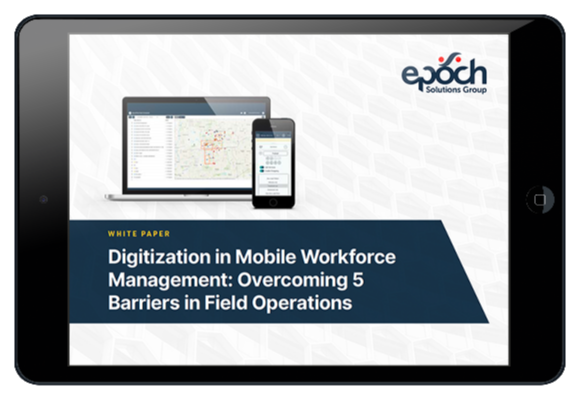
Digitization in Mobile Workforce Management: Overcoming 5 Barriers in Field Operations

The pandemic added a level of urgency to digitization in utilities unlike anything the industry has ever seen. And yet, for many companies, the ongoing work towards digital transformation has been anything but smooth.

In this report, we cover some of the barriers we’ve seen firsthand as companies follow the path to streamlining and simplifying end-to-end mobile workforce management.

Read the guide to learn:

  • How digitization is reshaping field operations and bridging the gap between field and office workflows
  • The top 5 obstacles companies face when implementing technologies meant to promote digital ways of working
  • How to overcome these challenges with a phased, achievable roadmap to digitization

Download the White Paper

Gradient Navy Teal Workflow Automation

Digitization in Mobile Workforce Management

Utilities often face challenges such as legacy systems, disconnected field and office workflows, resistance to change, limited real-time visibility, and difficulty integrating new technologies with existing infrastructure. Overcoming these barriers requires a phased, strategic approach to digitization that streamlines workflows, improves communication between field and back-office teams, and centralizes operational data.

Digitizing mobile workforce management connects field crews with real-time data, automated scheduling, and centralized work order management tools. This reduces manual processes, bridges gaps between field and office operations, accelerates decision-making, and enables utilities to operate more efficiently across large and complex service territories.

GIS integration is critical because utilities rely on accurate asset location, network tracing, and real-time outage visibility. Without integration between mobile workforce and GIS systems, routing, scheduling, and impact analysis suffer. A map-first solution ensures crews can access reliable data online or offline, improving precision, speed, and operational decision-making.

Utilities create a single source of truth by integrating ERP, OMS, GIS, and mobile systems into a centralized platform. Eliminating data silos reduces errors, duplicate work, and IT burden. Standardized workflows ensure field and office teams use the same real-time information, improving visibility, reporting accuracy, and resource allocation.

Utilities should follow a phased roadmap: define the business case, assess current systems, implement aligned technology, train crews, and continuously optimize. Aligning workflows with enterprise strategy and working with an experienced implementation partner reduces disruption and ensures scalable, long-term digital transformation.